About AI
14 September 2026
Especially in the last couple of years, we have seen an incredible amount of progress made with AI / Machine Learning. Like many people, I was amazed at the sight of generated images and, eventually, videos. Imagination could become something visual with just a written prompt. As soon as more and more corporations started integrating “AI Features” into their existing products and forcing them on customers, it took a turn for the worse.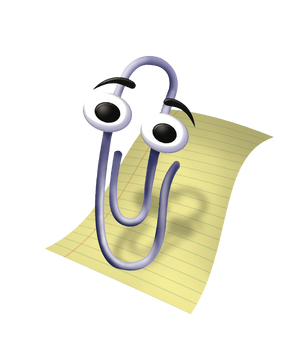 We used to make fun of Clippy, Microsoft’s late-90s intrusive
“helper” within Windows. Now suddenly, everything has its own
version in the form of an “AI Assistant”. In my real-life job, I
manage a facility for people with disabilities. It is mostly an
office job. Seeing AI-generated answers recommended when I
received an email is beyond unnecessary and, frankly, sometimes
absolutely ridiculous.
We used to make fun of Clippy, Microsoft’s late-90s intrusive
“helper” within Windows. Now suddenly, everything has its own
version in the form of an “AI Assistant”. In my real-life job, I
manage a facility for people with disabilities. It is mostly an
office job. Seeing AI-generated answers recommended when I
received an email is beyond unnecessary and, frankly, sometimes
absolutely ridiculous.
But while I find that annoying, it isn’t
my main gripe with AI. It is actually how we use it. We
are using AI as a replacement for creativity, (paid) labor,
human-made design, and decision-making. It has basically become
the go-to tool for everything, when actually, it should be a very
specific tool for a very specific job.
At the BlackRock Infrastructure Summit in 2026, Sam
Altman said:
“We see a future where intelligence is a utility like electricity or water, and people buy it from us on a meter and use it for whatever they want to use it for.”
This,
to me, sounds terrifying. And I think that mindset of “AI
Everywhere” is what is driving me and others away from it –
even when it actually has some real-life usage and benefit.
An example:
one of our clients cannot speak. He will never learn to speak
because it is physically impossible for him. He can't read or
write either. He has a “Talker”, a tablet device that can output
speech through symbols (pictograms). But because he has also a
mental disability, using the Talker is difficult and cumbersome
for him. Imagine trying to form a sentence with just images, when
most images -words- are in different categories. You would think
that this is already difficult. Now imagine doing that in the
German language; a language with one of the most complex grammars
in the world.
An
AI-assisted Talker could help him form sentences with
understandable, correct grammar, with just 5 buttons in one menu
instead of 10 buttons spread across different menus. It would lead
him to being able to speak more freely and be understood by
everyone (Germans can be very impatient with language barriers and
false grammar).
My Point:
AI can be
very useful if used correctly and consciously. AI should never replace
artistry, creativity, decision-making, or human interaction.
AI isn’t a danger or poisonous to the human mind, but it should
not replace thought processes, critical thinking, or real
interaction. I do find use cases for AI in terms of enabling
people or great ideas, which would otherwise not be possible. AI
is a tool - It's up to us to decide how we use it.